


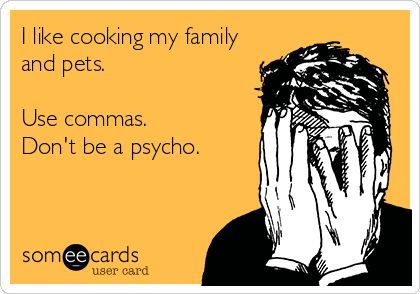
“I like cooking my family and pets. Use commas. Don’t be a psycho.”
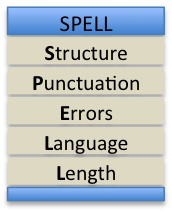 Check out this blog post about writing great sentences:
http://www.writingandspeakingforbusiness.com/blog/spell-making-sense-of-sentences


At certain times and in certain documents, addressing the reader as “you” is acceptable. When writing a letter, for example, addressing the reader is common. Many of your business documents will be to a specific person and you will use “you” to address your reader.
The problem with addressing the reader as “you” comes when the writer does not mean the reader specifically. “You” is often used to make generalizations but can make for confusing and inaccurate sentences.
For example, the following sample sentence appeared in a memo to a professor:
The author is writing to a professor, so it is unlikely that the professor is looking for job opportunities presented by a general business degree. The author either means to generalize or refer to him/herself. Therefore, either of the following examples is more accurate:
Writers should pay careful attention to their intended meaning and use either first person (I, me) or third person (they, people) in their writing. Do you (the reader of this document) mean to address your reader?
photo credit: J E Theriot via Compfight

In the business world, one wants to appear assertive and confident. Using “hedging” or conditional words undermines the reader’s confidence in the writer.
The most common words that undermine a writer are: seems, appears, maybe. To make your writing more assertive, delete these conditional words. Some examples appear below.
Now that you have seen some examples, look for conditional words in your writing and eliminate as many as possible.

Why Does my Paper Say “Ref”?
 Tennessee Journalist via Compfight
To ensure your writing is clear and easy to read, pronouns must clearly refer to a noun in the current or previous sentence. The reader must know what noun the pronoun is replacing. The “ref” designation on an edited piece of writing means the referent is unclear.
A pronoun refers to a noun (he/she, they, them, it etc.)
An antecedent (or referent) is the noun to which the pronoun refers.
Identify the pronoun and antecedent in this sentence:
The pronoun is “they.” “The antecedent is “students.” This sentence is clear.
In this sentence, the reference is unclear:
The pronoun is “his” but the reader does not know if the “his” is John or Bill. This sentence is unclear because the reader cannot tell who loves the IPod.
Another example shows confusion in sentences in which two or more nouns are possible antecedents. The following sentence is unclear:
(Who told whom?)
This revision is clear:
Confusion also occurs when the pronoun does not have an antecedent or the antecedent is implied. This sentence is unclear:
The “it” in the second clause does not have an antecedent, which makes the sentence confusing. The following revision is correct:
The rules to ensure clear pronoun referents are:

Are your sentences clear and easy to read or messy and confusing?

Creating clear sentences is essential for all writers. Some common sentence structure problems are explained below.
Agreement means the subject (noun, doer of action) and verbs (the action) must agree in number and tense:
Sentences must end with a period or other punctuation.
Fused sentences are complete sentences run together without punctuation; to fix, separate sentences with a period, a conjunction (and, but etc.), or a semicolon.
Comma splices are two sentences (independent clauses) joined by a comma; to fix, replace the comma with a period, a conjunction (and, but etc.), or a semicolon.
Sentence fragments are phrases that lack a subject or verb.
Edit your writing carefully to avoid these sentence structure errors.

Writers often use “This” to refer to the subject of the previous sentence. However, using the pronoun “this” alone is sometimes called a Lonely This. A subject should follow a “This.”
A Lonely This looks like:
In each of these examples, the reader does not know to what the “This” refers. The “This” is lonely because it doesn’t have a subject.
Writers should identify the “This” as in the following examples:
In these examples, the “This” is followed by a noun. The more specificity in your writing, the easier it is to read because the reader doesn’t have to re-read sections to determine your subject.