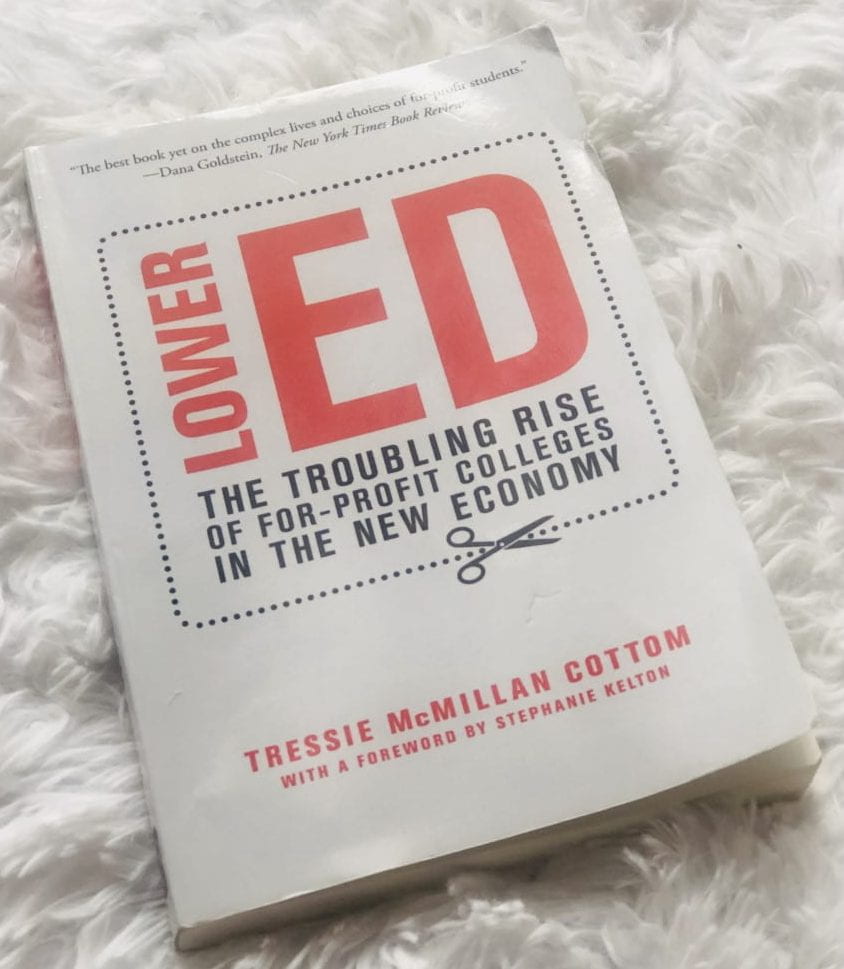
In our Spring 2020 HiEd820: The College Student course, doctoral students had the opportunity to choose between writing a book review and participating in a course discussion. This assignment, created by Dr. Brittany Williams, was developed to help students explore academic writing forms beyond the traditional paper format and to give students an opportunity to interweave a book review with other assigned course readings. The following review was created by first-year doctoral student Kimberley Turner-Rush. Given the distance between the books’ publication and the changing realities of higher education in the current political landscape, this text remains relevant to all who seek to serve and support students on campus. If you’re looking for a quarantine read that can shed light on educational precarity and access issues, this book should be on your list.
— Brittany M. Williams, Ph.D.
LOWER ED: The Troubling Rise of For-Profit Colleges in the New Economy (Review)
Cottom, T.M. (2017). Lower Ed. The Troubling Rise of For-Profit Colleges in the New Economy. New York, NY. The New Press.
Many have viewed education as a way to change the trajectory of an entire family for generations to come (Song, 2016). Cottom’s (2017) book, Lower Ed: The Troubling Rise of For-Profit Colleges in the New Economy, provides readers insight on how students’ socioeconomic status plays a role in higher education. Cottom not only addresses attainment, but also the types of educational opportunities that are available to students as well as how the systems in place can both discourage their participation and take advantage of their desire for participation.
Championed as the great equalizer, higher education has been dangled like a carrot to lower- and lower-middle-class people as a way to climb the socioeconomic ladder to a better life.

Currently an Associate Professor in the Department of Sociology at Virginia Commonwealth University, Cottom hails from a professional background of working at both for-profit and not-for-profit institutions of higher education. Her experience provides insight into practices of enrolling students in programs that, more often than not, do not meet the expectations outlined and can often leave students in financial distress. Cottom’s disdain for these practices is evident as she proclaims, “the idea that higher education is a moral good is allowable only insofar as higher education serves market interests.”
When we remove the notion that, for many, obtaining higher education is more about job attainment and less about the social good, we are forced to look in the mirror and ask whether or not the work of higher education institutions as we currently conceive it functions for all students who are enrolling with the hope of a brighter future. Cottom provides the reader with insight or themes impacting how we, as practitioners, interact with students as well as how we should be working with populations of students who need our services most.
When reading Lower Ed, themes that practitioners should consider emerge regarding processes for recruiting and enrolling students, labor market drivers for programming, and organizational structures to support students determined to complete a college education. These takeaways should continue to be at the forefront of discussions of higher education practitioners and shape how we serve our students. It is our responsibility to rethink both our purpose(s) as higher education practitioners and our understanding of what students want (and need) from our institutions.
Recruitment and Enrollment Practices
Cottom remarkably illustrates how the “flexible solutions” offered by the for-profit schools continue to exacerbate social inequities and foster discrimination.
Students enrolling in these programs are less likely to have attended good K-12 schools that offer college prep courses. They are more likely to face food and housing insecurities (AAC&U News, 2019) and less likely to have access to standardized test prep. By seeking education at a for-profit institution, they are more likely to take on higher debt to cover the higher costs.
The not-for-profit sector must find ways to allow flexible enrollment schedules, online courses, and online program completion as just a few of the benefits students can expect. Additionally, many for-profit institutions do not require developmental courses, so students start immediately on their chosen academic path. In addition to finding ways to better accommodate the for-profit demographic, we must do so in a way that reduces equity gaps as these students are more likely to fall into a group that Anthony Jack refers to as the doubly disadvantaged (2015). Cottom indicates that students often feel pressured into signing enrollment agreements and that they do not fully understand the burden of this debt.
Doubly Disadvantaged
Jack’s (2015) work compares the experience of students of color who enter college from local, public high schools (doubly disadvantaged) and those students of color who graduate from preparatory or boarding schools (privileged poor). These distinctions are essential in understanding the needs of the students we serve. The doubly disadvantaged have had little access to the resources that make college transition smooth and college completion attainable. These students are unaware that professors expect students to reach out if they need help and expect students to seek assistance when obstacles arise. Using the close relationships with our K-12 partners, not-for-profit institutions of higher education are positioned to have discussions on how to close these gaps. If we fail to do so, we are complacent and are further enabling a system that, as Cottom indicates, continues to exacerbate social inequities and fosters discrimination.
Labor Market Drivers
Students enrolled in for-profit institutions tend to be women, people of color, and single parents who are of lower socioeconomic status than their traditional college peers (Cottom, 2017). For many of these individuals, a college education provides preparation for a job, knowledge needed for a better job, or credentials required to pursue a coveted position and be competitive in the job market.

While access barriers are a large driver to for-profit undergraduate programs, why do for-profit graduate degrees continue to flourish? Cottom offers one example that focuses on a group of black women enrolled in online PhD programs offered mainly through the University of Phoenix, Capella University, and Walden University. These women, known as Sisters Working to Achieve Greatness (SWAG), are obtaining what Cottom refers to as up-market degrees at a much higher cost without the off-setting opportunities such as teaching assistantships or institutional aid. Up-market degrees are “credential sequences that start at the lower level, with higher degrees stacked on top as demand increases” (Cottom, 2017). The women of SWAG are spending $92,000 to $180,000 for degrees (up to and including the doctorate) through student loans. While these women see the cost as a good investment, others Cottom follows view education as a means to add letters behind their name for the perceived prestige those letters provide.
Organizational Structure and Student Support
One way that community colleges strive to support students is through innovation and wrap-around services such as childcare resources, tutoring, transportation, etc. (Dembicki, 2019).
Cottom counters with the fact that the understaffing of community colleges in service areas, overcrowding, and demands of remedial or developmental courses put strains on these institutions and leave students to overcome these obstacles on their own. Obstacles that students are less likely to face in the for-profit sector.
It is evident that the current not-for-profit systems are not meeting students’ needs in overcoming these obstacles. Much of this relates to the difference in funding structures between not-for-profit and for-profit institutions. To improve these systems and be better positioned to meet the needs of students, community colleges (and four-year institutions) will need a better funding model that offers incentives for the necessary changes to be made. Until then, Cottom offers focus areas (themes) that practitioners can use when developing or updating services and programs that serve the students most in need of our support. Perhaps we should all heed her advice.
References
AAC&U News. (2019). Majority of College Students Experience Food Insecurity, Housing Insecurity, or Homelessness.
Cottom, T. M. (2017). Lower Ed; The Troubling Rise of For-Profit Colleges in the New Economy. The New Press.
Dembricki, M. (2019). Wraparound services and student success. Community College Daily. Retrieved http://www.ccdaily.com/2019/05/wraparound-services-student-success/.
Jack, A. (2015). “What the Privileged Poor Can Teach Us.” The New York Times.
Jack, A. (2019, June 13). On Diversity: Access Ain’t Inclusion. TEDxCambridge. https://youtu.be/j7w2Gv7ueOc.
Jack, A. (2019, March 6). The Privileged Poor. YouTube. https://youtu.be/ZXKKmPCZPDc
Song, X. (2016). Diverging Mobility Trajectories: Grandparent Effects on Educational Attainment in One- and Two-Parent Families. Demography. 53(6). 1905-1932.
U.S. Department of Education. College Affordability and Completion: Ensuring a Pathway to Opportunity. https://www.ed.gov/college.
About the Author:
Kim Turner-Rush is an instructor of business at Saint Paul College. She lives in downtown Saint Paul, a transplant from Cincinnati, OH. She holds a M.A. in Higher Education Administration and an MBA from Morehead State University. Currently, Kim is enrolled in the Higher Education Administration doctoral program at Saint Cloud State University.
Смотреть дорамы онлайн, смотреть дорамы 2026 онлайн
— это отличный способ провести
время.
ty le keo malaysia|cac trang ca cuoc uy tin|keonhacai2.com|100.000 euro bằng bao nhiêu tiền việt nam|trang đánh đề|ty le ca cược|nm88|nhà cái uy tín top1cacuoc trang đánh đề
CM88 là nhà cái trực tuyến được nhiều người chơi quan tâm nhờ hệ thống giải trí đa dạng và giao diện thân thiện. Nền tảng này cung cấp nhiều sản phẩm cá cược như thể thao, c.a.s.i.n.o, bắn cá và slot game, đáp ứng nhu cầu giải trí của đông đảo người dùng. Với quy trình đăng ký đơn giản, CM88 hướng tới trải nghiệm thuận tiện và ổn định cho người chơi.
https://sc88.social/ SC88 là điểm đến lý tưởng cho người yêu cá cược online. Hệ thống ổn định, thanh toán linh hoạt, khuyến mãi liên tục giúp người chơi an tâm giải trí và gia tăng cơ hội chiến thắng.
trang chủ TT88 cam kết bảo mật thông tin tuyệt đối giao dịch an toàn 100%.
trang chủ MMOO hỗ trợ nạp tiền đa kênh tiền về tức thì bắt đầu chơi.
các nhà cái nổi tiếng|cá cược 88|tỷ lệ cược|link vào 88|nhà cái uy tín top1cacuoc|nha cai uy tin nhat|đăng ký lucky88|nhà cái uy tín bmktx các nhà cái nổi tiếng
hermes 高仿包包|A貨項鏈|高仿項鏈|高仿錢夾|A貨錢包 高仿項鏈
高仿手錶|A貨梵克雅寶|A貨皮夾|A貨手袋|高仿皮夾|A貨錢夾|A貨衣服|LV高仿包包 高仿皮夾
A貨梵克雅寶,A貨手袋,A貨皮夾,A貨項鏈,Vacheron Constantin高仿手錶,高仿香奈兒,復刻手錶 高仿香奈兒
Slot Gates of Olympus đang nổ x500, trang chủ 789P chờ anh em vào quẩy!
trang chủ NOHU90 hiển thị ưu đãi tân thủ hấp dẫn kèm thưởng nạp lần đầu cao nhất thị trường.
https://go99x.app/ là cổng game đổi thưởng đáng tin cậy số 1 Việt Nam.
CHANEL 高仿包包|高仿項鏈|A貨包包|高仿手環|A貨鞋子|A貨梵克雅寶|GUCCI高仿包包|Omega高仿手錶|LV高仿包包|A貨腕錶 GUCCI高仿包包
SC88 đang trở thành lựa chọn hàng đầu của hàng triệu thành viên yêu thích cá cược trực tuyến tại thị trường châu Á hiện nay. Nền tảng sở hữu kho game khổng lồ cùng hệ thống bảo mật tiên tiến giúp mọi người hoàn toàn yên tâm khi tham gia giải trí. SC88 cam kết chi trả thưởng nhanh chóng và minh bạch cho tất cả các bạn đăng ký thành công tài khoản.
fly88 giúp kết nối cộng đồng người chơi trong môi trường giải trí trực tuyến chung
lc88 thường xuyên cập nhật trò chơi mới nhằm mang đến trải nghiệm tươi mới cho người tham gia.
https://vmax.tech/ dang tro thanh lua chon duoc nhieu nguoi quan tam nho mo hinh giai tri von thap, de tham gia va co ma thuong 1000 ty hap dan.
Paito HK
高仿項鏈|A貨手袋|高仿手袋|Omega高仿手錶|復刻腕錶 復刻腕錶
kèo cá cược bóng đá ý|ty le ca cuoc|ty le keo ngoai hang anh|link m88 moi nhat|fun88 đối tác chính thức|nhà cái uy tín taxi|nhà cái uy tín fan|link vao fun88 fun88 đối tác chính thức
Tham gia Kubet – cổng game đổi thưởng xanh chín được yêu thích nhất 2026, nạp rút tiện lợi, hỗ trợ đa kênh và kho game phong phú từ nổ hũ đến thể thao ảo 24/7.
888VND trang chủ hỗ trợ tiếng Việt hoàn chỉnh, giúp người chơi thao tác dễ dàng và thuận tiện hơn.
nhà cái uy tín protop|nha cai uy tin bmktx|xem keo nha cai|ca cuoc bong|link 12bet|tỷ lệ cá cược bóng đá|kèo bóng đá m88|m88 com link nhà cái uy tín protop
香港猫池|短信设备|猫池设备|猫池购买|短信猫池|卡池|越南猫池设备|新款猫池|4g猫池设备 4g猫池设备
Nạp 1 nhận 2 siêu hot đang diễn ra tại 13Win kênh chính thức 2026, đừng chần chừ mà bỏ lỡ cơ hội vàng!
A貨愛馬仕|A貨項鏈|prada 高仿包包|高仿包包|復刻手錶|名牌精品 A貨愛馬仕
https://sc88.today/ SC88 – điểm đến lý tưởng cho người yêu cá cược trực tuyến. Giao diện thân thiện, tỷ lệ thưởng cạnh tranh, thanh toán linh hoạt và đội ngũ CSKH tận tâm hỗ trợ mọi lúc mọi nơi.
有道翻译电脑版下载|有道翻译最新版下载|网易有道翻译|有道灵动翻译|有道AI翻译|有道翻译官|有道翻译电脑版|有道翻译下载 有道翻译电脑版
hubet nơi hội tụ cược thủ đam mê trải nghiệm kèo cháy máy thắng thua rõ ràng uy tín
高仿鞋子|A貨梵克雅寶|仿包|Patek Philippe 高仿手錶|A貨項鏈|高仿手錶 高仿鞋子
GUCCI高仿包包|A貨包包|高仿皮夾|A貨手環|A貨錢夾|高仿香奈兒|A貨梵克雅寶 高仿皮夾
有道翻译|有道翻译下载|有道翻译官|有道翻译最新版下载|有道AI翻译|有道翻译电脑版下载|网易云有道翻译|有道翻译电脑版 有道AI翻译
新款猫池|短信猫池|卡池|菲律宾猫池|越南猫池设备|短信设备 短信猫池
高仿包包|高仿鞋子|prada 高仿包包|A貨愛馬仕|hermes 高仿包包|高仿運動鞋|高仿衣服|高仿腕錶 高仿運動鞋
高仿手袋|名牌手錶|A貨腕錶|ROLEX高仿手錶|高仿錢包|高仿精品|仿包|A貨香奈兒|A貨鞋子 ROLEX高仿手錶
https://rr8867.com/ khẳng định vị thế dẫn đầu thị trường khi chính thức công bố thương vụ hợp tác chiến lược cùng siêu sao bóng đá Harry Kane. Sự kiện chấn động này không chỉ minh chứng cho độ uy tín, tiềm lực tài chính mạnh mẽ của nhà cái mà còn mang đến cơ hội trải nghiệm cá cược đẳng cấp quốc tế cho người chơi. Khám phá ngay hành trình đầy hứa hẹn này!
名牌精品|仿包|名牌手錶|A貨腕錶|高仿愛馬仕 名牌精品
trang ca cuoc bong da|tile keo hom nay|lien ket ca cuoc|link vào bóng|trang m88|m88 vin link|kèo nhà cái số 1|đăng nhập 12bet kèo nhà cái số 1
trang vao m88|game nhan thuong|m88 bị chặn|nha cai uy tin nhat hien nay|nhà cái uy tín 88 trang vao m88
A貨香奈兒|LV高仿包包|高仿皮夾|高仿錢包|Vacheron Constantin高仿手錶|Omega高仿手錶|prada 高仿包包|高仿精品 Omega高仿手錶
hytw3339 com là một trong những nhà cái trực tuyến đang thu hút đông đảo người chơi tại Việt Nam và khu vực châu Á. Với hệ thống bảo mật tiên tiến và dịch vụ chăm sóc khách hàng chuyên nghiệp, người chơi luôn được đảm bảo về chất lượng trải nghiệm. Bài viết dưới đây sẽ giúp bạn hiểu rõ hơn về nhà cái và những giá trị mà nhà cái này mang lại.
sc88 là một trong những nhà cái trực tuyến đang thu hút đông đảo người chơi tại Việt Nam và khu vực châu Á. Với hệ thống bảo mật tiên tiến và dịch vụ chăm sóc khách hàng chuyên nghiệp, người chơi luôn được đảm bảo về chất lượng trải nghiệm. Bài viết dưới đây sẽ giúp bạn hiểu rõ hơn về nhà cái và những giá trị mà nhà cái này mang lại.
A貨鞋子,LV高仿包包,高仿運動鞋,復刻手錶,A貨錢夾,高仿梵克雅寶 LV高仿包包
keo nha cai bet 69|trang web ca cuoc uy tin|nhà cái trực tiếp|linkbong 88|top nha cai uy tin|cá cược châu á|tỷ lệ kèo châu âu|cá độ bóng đá uy tín cá cược châu á
A貨皮夾,高仿手錶,高仿錢夾,prada 高仿包包,A貨包包,GUCCI高仿包包,高仿包包,A貨項鏈,名牌包包 名牌包包
kp88.com được đánh giá là một trong những nền tảng giải trí có định hướng phát triển bền vững và rõ ràng. Đặc biệt nền tảng còn tạo ra cảm giác yên tâm trong suốt quá trình trải nghiệm. Chính những điều đó đã khiến thương hiệu trở thành một lựa chọn đáng tin cậy để bạn dành thời gian tìm hiểu kỹ hơn.
Treasure Level Start Boom Riches Thrill Luck Unlock Prize INDOSLOT
GG88 là nhà cái trực tuyến được nhiều người chơi quan tâm nhờ hệ sinh thái cá cược đa dạng và nền tảng vận hành ổn định. Sân chơi này cung cấp cá cược thể thao, c.a.s.i.n.o trực tuyến và slot game, đáp ứng nhu cầu giải trí đa dạng. Bên cạnh đó, GG88 chú trọng bảo mật, tốc độ giao dịch và dịch vụ hỗ trợ chuyên nghiệp.
Win Triumph Boost Action Live Fun Epic Gold Join INDOSLOT