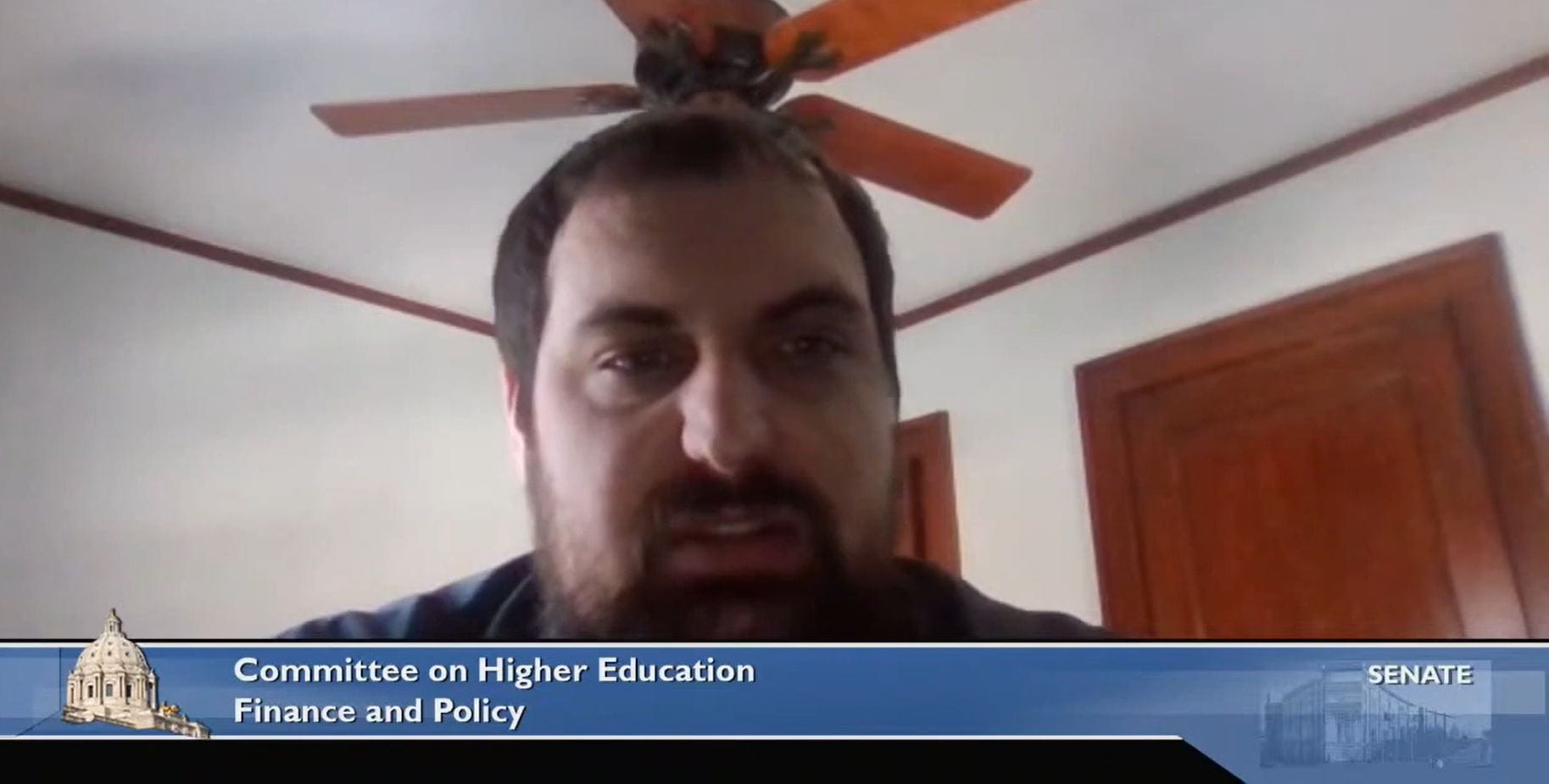
Fall 2020 HiEd Masters Alumni David Thompson testified before congress on his work and understandings of food insecurity. Read on to hear some of his reflections on this journey and the full testimony below.
Addressing Student Food Insecurity in Minnesota
 In 2019, I wrote an article describing the devastating effects that food insecurity can have on college students. In that piece, I shared the work that I and others had begun to address student food insecurity at St. Cloud State University. Since then, we have made great strides in our efforts to support food insecure students. Fortuitously, our efforts largely coincided with the COVID-19 pandemic, which has hit students particularly hard, stripping many of the basic needs security they previously enjoyed while exacerbating the situation of already struggling students.
The pandemic’s impact on students’ basic needs security has not gone unnoticed by state and federal policymakers who appear to be tackling the issue with a meaningful sense of urgency. In Minnesota, for example, the legislature is considering several bills to address the issue, including funding for emergency assistance grants and the creation of a basic needs resource hub for students. As a result, basic needs security advocates have an opportunity to move beyond campus-level solutions and advocate for long overdue structural changes both within our home states and throughout the nation. To exemplify this opportunity, I offer an account of my recent experience testifying to Minnesota’s Senate Committee on Higher Education Finance and Policy in support of expanding the state’s Hunger Free Campus Act.
Before diving into the testifying itself, some background about how the opportunity came about. In January 2020, the Huskies Food Pantry opened, providing students with access to free, healthy foods. I was fortunate to play a role in the pantry’s efforts as part of my practicum with the higher education program. In this capacity, I developed an assessment plan to help measure progress toward building a sustainable food supply and meeting students’ needs. I also initiated a partnership with SCSU’s Student Parent Support office that enabled the pantry to offer diapers and baby wipes to parents using the pantry. Meanwhile, the pantry’s director, Beth Knutson-Kolodzne, secured multiple grants to keep the pantry stocked with an array of culturally diverse foods that met the varied dietary needs and preferences of all SCSU students.
As the pandemic worsened, the pantry became an increasingly vital resource for students, and the campus community responded generously to calls for support. Still, the pandemic also created challenges as changes to campus operations forced the pantry to move locations multiple times before settling into its new home in Hill Hall. Moreover, pantry staff had to quickly implement a contactless order and pick-up process through HuskiesConnect. To support students with needs beyond food, I helped create a basic needs resource pamphlet that provided students with information about food, housing, transportation, and other resources available in the area.
Given all the pantry team had accomplished in such a short time, I hoped that SCSU would be able to secure designation as a Hunger Free Campus. Awarded by LeadMN, a student-led association of Minnesota’s colleges and universities, this designation is awarded to institutions meeting certain criteria related to promoting student food security, including having a campus food pantry, designating a staff person to provide education about SNAP and other benefits, and offering emergency assistance funds. Unfortunately, while exploring the possibility of SCSU receiving the designation, I learned that the current Hunger Free Campus Act only covered Minnesota’s two-year community and technical colleges.
Now, that might have been the end of the story except for a chance encounter I’d had in the summer of 2019. Then a new resident of St. Cloud, I stopped by the Benton County Fair to check out the animal exhibits and scarf down some fair food. While there, I also visited the exhibition hall to learn more about organizations in the community. It was there that I met then State Senate candidate, Aric Putnam. Putnam and I spoke for a good half-hour, discussing our respective backgrounds, the St. Cloud community, our political beliefs/priorities, and, most importantly, our shared love of Great Danes. During our conversation, Putnam didn’t go for the hard sell. Instead, he repeatedly indicated that he didn’t want anyone’s vote until he’d proven that he would do the work and that he expected folks to call him out if he dropped the ball. In meeting with, and subsequently volunteering for, Putnam in the months that followed, it became evident that these remarks were not a political facade but the core of who he is.
 During our conversations, I repeatedly shared my focus on addressing college student food insecurity. When Putnam won the election, I offhandedly made a remark about him expanding the Hunger Free Campus Act to include Minnesota’s four-year institutions and, if he felt lucky, attaching some funding as well. He replied, “You got it.” Still, I didn’t think much of the exchange at the time, knowing the myriad challenges he would have to tackle upon entering office. Thus, it was a surprise when Putnam reached out in January to tell me he had been named to the Senate Committee on Higher Education Finance and Policy and that he was getting to work on an expanded Hunger Free Campus Act. Over the following weeks, Putnam checked in to share progress, letting me know about meetings with LeadMN and other student groups and sharing an initial draft of the bill. He also offered me an opportunity to speak with the St. Cloud Times for an article about the Hunger Free Campus Act (subscription required). That was a relatively new experience for me, and I scrambled to remember the tips I’d learned about speaking with the media during my University-Community Relations course.
Following the interview, updates from Putnam died down, so I assumed I had played my part and the rest was up to him and the legislature. Then, a few weeks ago, Putnam reached out again to ask if I wanted to testify to his committee about the bill. Though firmly in uncharted waters, I agreed and began drafting some initial thoughts about what I would say. Over the next few days, Putnam shared more about the testimony plan, including the names of additional testifiers and the specific information he wanted me to discuss: causes of student food insecurity and the scope of the issue in Minnesota. With this more specific gameplan, I began trimming down my remarks to my allotted 4-5 minute speaking time. I was also able to incorporate some of my knowledge from a research paper I co-authored (first) with Dr. Williams which we recently submitted for publication review.
When the day of the committee meeting arrived, I donned my official SCSU higher ed apparel and set up my Zoom-friendly space. I practiced my remarks a few more times until I was confident that I was ready, and then…the meeting was rescheduled because a debate on the Senate floor ran long. Already prepared, I didn’t expect to do much but wait until the new meeting day. That carefree plan was disrupted when Putnam informed us that the committee had added additional bills to the agenda, meaning we needed to cut another minute or two from our remarks. So, I took the hatchet to my testimony to fit my further slimmed down speaking time.
All too quickly the rescheduled meeting day arrived. As before, I donned my SCSU apparel, set up my Zoom space, and pulled up my remarks on a Kindle for easy reference. We were second on the agenda, which helped me get a feel for the tone of the meeting. It was an interesting mix of formal and informal with the committee chair discussing points of order and calling for motions while committee members interspersed (bad) jokes in between pointed questions. When our turn arrived, I listened to the compelling mix of data and personal experience shared by Senator Putnam, LeadMN President Priscilla Mayowa, and Minnesota Student Association Fellow Gabe Hafemann. My own remarks went by in a bit of a blur as I focused on maintaining a quick pace while trying not to stumble or stray off topic. Our team fielded some brief, but supportive, questions before turning the session over to testimony about the state’s Workforce Development Scholarship program. I was unfamiliar with the program; however, it resonates strongly with our efforts to support students’ basic needs, a sentiment that was echoed by the individuals testifying in support of the program.
https://www.youtube.com/watch?v=yj8fo62I1Qc&t=1100s
While I certainly felt the pressure of the moment, testifying was a deeply affirming experience for me. I was able to draw upon the knowledge and experience I gained from the higher education program to advocate for students’ basic needs at a level where lasting change can be made for Minnesota students of today and tomorrow. I encourage all of fellow Husky students and alumni to seek out similar opportunities to have your voice heard in the legislative process. Connect with local politicians, student organizations, and advocacy groups. As I discovered after a chance meeting at a county fair, you never know who your staunchest allies might be nor where you might meet them.
David J. Thompson is a Fall 2020 graduate of the SCSU HiED masters program. He is currently job searching. David is seeking opportunities within mid-Minnesota and/or online (and work from home) to support students with securing their basic needs necessities.
If you’re experiencing slow loading time or are unable to log into Fortnite on PS4 or PS5, try restarting your Fortnite game client. fortnite not working on ps5 after update
Simply breathtaking – I’m in awe.
link terbaru
Thanks for sharing, it’s really helpful wiki
Thank you for your share, this article is stunning! H19-462_V1.0 Cert Exam offers outstanding content, all for free.
Your article was so refreshing, I really appreciate it. Free Reliable 312-76 exam cram review shared to help you improve your IT skills. Best of luck!
This is the kind of analysis we need more of—clear, concise, and full of substance bandarlotre
Great post! You explained a chaotic situation in a really calm, understandable way bandarlotre
Xhs1991の発展は弊社の商品を利用してIT認証試験に合格した人々から得た動力です。今日、我々があなたに提供するCWNPのCWAP-404ソフトは多くの受験生に検査されました。彼らにCWNPのCWAP-404試験に合格させました。弊社のホームページでソフトのデモをダウンロードして利用してみます。我々の商品はあなたの認可を得られると希望します。ご購入の後、我々はタイムリーにあなたにCWNPのCWAP-404ソフトの更新情報を提供して、あなたの備考過程をリラクスにします。
Love how you guide us with kindness bandarlotre
Really love the simple way you explain things bandarlotre
I appreciate your article, it really made me see things differently. We’ve made Reliable study guide SAA-C03 ppt freely available, packed with content to help you succeed.
Can I get your affiliate link to your host? D. 제트벳
I wish my web site loaded up as fast as yours lol D. 룰라벳
I’m going to watch out for brussels. D. KRWIN
Your article was truly enlightening and refreshing, thank you! This is the HPE2-T37 new practice questions pdf exam I took for my promotion and salary increase. It’s free for you today—wishing you all success in your careers!
What a beautiful article, I appreciate you sharing it with us! P_BPTA_2408 test voucher is available to everyone for free, packed with content that can aid you.
Liking it because this content is awesome. Get free LLQP reliable free study questions to elevate your IT abilities. Best of luck in your exams!
It truly opened my eyes to a new world of ideas. Strengthen your IT expertise with free Latest test ATM tutorial. Best of luck in your studies!
The article provided me with immense value. Free Acquia-Certified-Site-Builder-D8 vce files resources are available! Best of luck to all!
Thank you for simplifying complex ideas. ผล หวย ฮานอย พิเศษ
This is where platforms like Y2mate.rent come into the picture, reshaping how we interact with online media.
Thank you for sharing your wisdom and insights with your readers.
dream gaming
Wir alle wissen, dass einige IT-Zertifikate zu bekommen ist in der heutigen konkurrenzfähigen Gesellschaft ganz notwendig ist. Das IT-Zertifikat ist der beste Beweis für Ihre Fachkenntnisse. Die SAP E-BW4HANA214 Zertifizierungsprüfung ist eine wichtige Zertifizierungsprüfung. Aber es ist schwer, die Prüfung zu bestehen. Es ist doch wert, Geld für ein Ausbildungsinstitut auszugeben, um im Beruf befördert zu werden. ZertFragen hat die zielgerichteten Schulungsunterlagen zur SAP E-BW4HANA214 Zertifizierungsprüfung, deren Ähnlichkeit mit den echten Prüfungen 95% beträgt. Wenn Sie an der Ausbildung von ZertFragen teilnehmen, können Sie dann 100% die Prüfung bestehen. Sonst geben wir Ihnen eine Rückerstattung.
I find the articles to be both insightful and practical. เว็บพนัน
Your article is so inspiring, thank you for sharing! Enhance your IT expertise and get free New composite test FCP_FAZ_AD-7.4. Wishing you all the best!
I’ve found ytmp3.rent useful for quickly converting YouTube audio files into MP3s—great for offline listening or repurposing content.
I am grateful for the impact your work has had on me.
สมัครสมาชิก 123bet
I really appreciate the effort that went into making this post so reader-friendly. The clarity and layout make it one of the better explanations I’ve seen. ติดต่อ ufabet
I’m truly grateful to the author of this content for the time, effort, and valuable insights shared. It was both helpful and inspiring, and it made a real difference in my work. I deeply appreciate the dedication and look forward to seeing more amazing content in the future. – run 567
Nice And Informative Website. Please Keep Continue Such Kind Of Effort. I Shared Your Post With My Friends Also. ทางเข้าเล่น ka gaming
Awesome post: Crispy Chicken Sandwiches
The article was so wonderful; it was truly astonishing! Boost your IT skills and enjoy free Dumps QSBA2022 PDF sharing. Wishing you success!
Thank you very much for this wonderful topic: 15 Best Things to Do in Mauritius
Great Post: https://veniceflordia.com/
In an era where accessories are as expressive as words, a Trump-themed wristwatch can serve as a daily reminder of one’s beliefs, style, or sense of humor.gettrumpwatches.com
Thank you for this incredibly informative article: Top 10 Overrated Travel Spots
Thank you for sharing this post. I hope you will share something more: https://barberofbridgton.com/
Very interesting and informative blog: 10 BEST Things To Do In Sri Lanka
Thank you for some other great article.
Top 4 Most Controlling Zodiac Sign
I appreciate you providing this important information: Papa’s Games
Thanks, website, for offering amazing tips and tricks. หวย ลาว ย้อน หลัง
Thanks for sharing
New Chili Crisp Chicken
I appreciate the useful post: Kawasaki Versys-X 300
This is the really nice post thx: Cleive Ester Adams
Your dedication to delivering high-quality content is evident in every word you write.
ebet
I apprreciate you sharing
Hormel New Dill Pickle
I admire your ability to tackle such complex topics with precision and grace.
123 สล็อต
The post highlights the growing crisis of student food insecurity in Minnesota and the commendable grassroots and legislative efforts to combat it, particularly through initiatives like the Huskies Food Pantry and the proposed expansion of the Hunger Free Campus Act. These efforts intensified during the COVID-19 pandemic, with leaders like Senator Aric Putnam taking actionable steps to address basic student needs. Food insecurity, as defined on Wikipedia, affects students’ health, performance, and retention. The testimony and advocacy work detailed show how local actions can influence statewide policy. Community-led initiatives like these are crucial in shaping equitable access to essentials, just like a thoughtfully curated Wg food menu supports diverse dietary needs.
Thank you very much for this wonderful topic
Tata Punch 2025
Very interesting and informative blog: Alto K10 2025