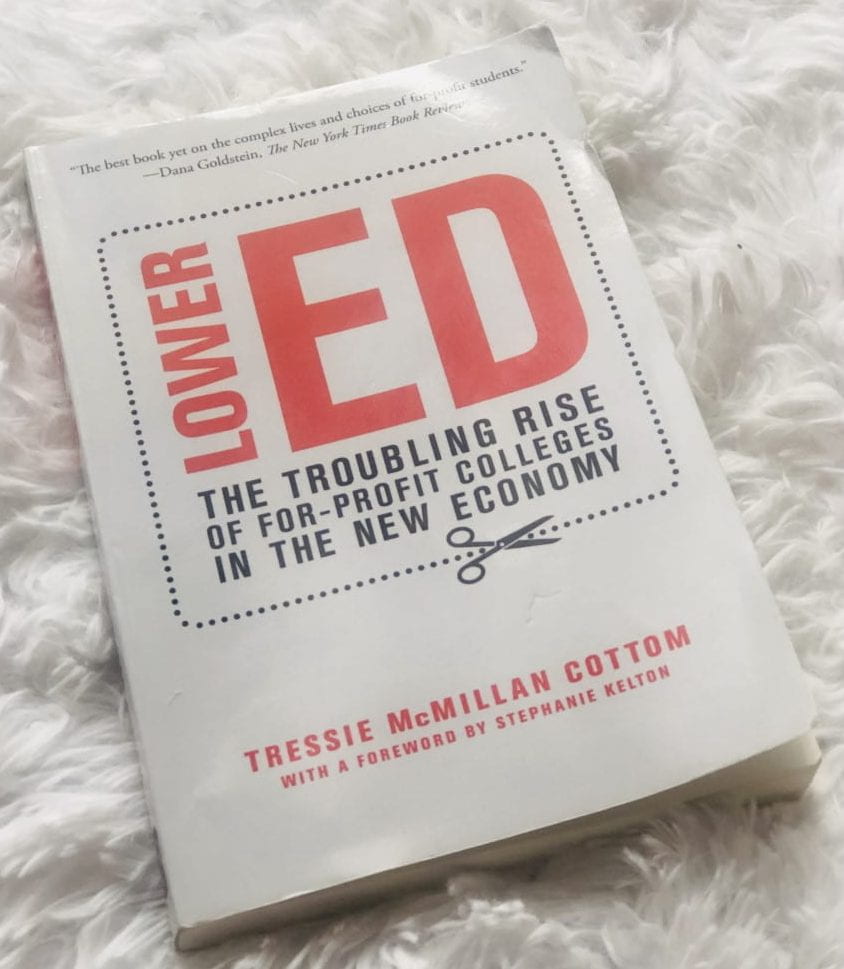
In our Spring 2020 HiEd820: The College Student course, doctoral students had the opportunity to choose between writing a book review and participating in a course discussion. This assignment, created by Dr. Brittany Williams, was developed to help students explore academic writing forms beyond the traditional paper format and to give students an opportunity to interweave a book review with other assigned course readings. The following review was created by first-year doctoral student Kimberley Turner-Rush. Given the distance between the books’ publication and the changing realities of higher education in the current political landscape, this text remains relevant to all who seek to serve and support students on campus. If you’re looking for a quarantine read that can shed light on educational precarity and access issues, this book should be on your list.
— Brittany M. Williams, Ph.D.
LOWER ED: The Troubling Rise of For-Profit Colleges in the New Economy (Review)
Cottom, T.M. (2017). Lower Ed. The Troubling Rise of For-Profit Colleges in the New Economy. New York, NY. The New Press.
Many have viewed education as a way to change the trajectory of an entire family for generations to come (Song, 2016). Cottom’s (2017) book, Lower Ed: The Troubling Rise of For-Profit Colleges in the New Economy, provides readers insight on how students’ socioeconomic status plays a role in higher education. Cottom not only addresses attainment, but also the types of educational opportunities that are available to students as well as how the systems in place can both discourage their participation and take advantage of their desire for participation.
Championed as the great equalizer, higher education has been dangled like a carrot to lower- and lower-middle-class people as a way to climb the socioeconomic ladder to a better life.

Currently an Associate Professor in the Department of Sociology at Virginia Commonwealth University, Cottom hails from a professional background of working at both for-profit and not-for-profit institutions of higher education. Her experience provides insight into practices of enrolling students in programs that, more often than not, do not meet the expectations outlined and can often leave students in financial distress. Cottom’s disdain for these practices is evident as she proclaims, “the idea that higher education is a moral good is allowable only insofar as higher education serves market interests.”
When we remove the notion that, for many, obtaining higher education is more about job attainment and less about the social good, we are forced to look in the mirror and ask whether or not the work of higher education institutions as we currently conceive it functions for all students who are enrolling with the hope of a brighter future. Cottom provides the reader with insight or themes impacting how we, as practitioners, interact with students as well as how we should be working with populations of students who need our services most.
When reading Lower Ed, themes that practitioners should consider emerge regarding processes for recruiting and enrolling students, labor market drivers for programming, and organizational structures to support students determined to complete a college education. These takeaways should continue to be at the forefront of discussions of higher education practitioners and shape how we serve our students. It is our responsibility to rethink both our purpose(s) as higher education practitioners and our understanding of what students want (and need) from our institutions.
Recruitment and Enrollment Practices
Cottom remarkably illustrates how the “flexible solutions” offered by the for-profit schools continue to exacerbate social inequities and foster discrimination.
Students enrolling in these programs are less likely to have attended good K-12 schools that offer college prep courses. They are more likely to face food and housing insecurities (AAC&U News, 2019) and less likely to have access to standardized test prep. By seeking education at a for-profit institution, they are more likely to take on higher debt to cover the higher costs.
The not-for-profit sector must find ways to allow flexible enrollment schedules, online courses, and online program completion as just a few of the benefits students can expect. Additionally, many for-profit institutions do not require developmental courses, so students start immediately on their chosen academic path. In addition to finding ways to better accommodate the for-profit demographic, we must do so in a way that reduces equity gaps as these students are more likely to fall into a group that Anthony Jack refers to as the doubly disadvantaged (2015). Cottom indicates that students often feel pressured into signing enrollment agreements and that they do not fully understand the burden of this debt.
Doubly Disadvantaged
Jack’s (2015) work compares the experience of students of color who enter college from local, public high schools (doubly disadvantaged) and those students of color who graduate from preparatory or boarding schools (privileged poor). These distinctions are essential in understanding the needs of the students we serve. The doubly disadvantaged have had little access to the resources that make college transition smooth and college completion attainable. These students are unaware that professors expect students to reach out if they need help and expect students to seek assistance when obstacles arise. Using the close relationships with our K-12 partners, not-for-profit institutions of higher education are positioned to have discussions on how to close these gaps. If we fail to do so, we are complacent and are further enabling a system that, as Cottom indicates, continues to exacerbate social inequities and fosters discrimination.
Labor Market Drivers
Students enrolled in for-profit institutions tend to be women, people of color, and single parents who are of lower socioeconomic status than their traditional college peers (Cottom, 2017). For many of these individuals, a college education provides preparation for a job, knowledge needed for a better job, or credentials required to pursue a coveted position and be competitive in the job market.

While access barriers are a large driver to for-profit undergraduate programs, why do for-profit graduate degrees continue to flourish? Cottom offers one example that focuses on a group of black women enrolled in online PhD programs offered mainly through the University of Phoenix, Capella University, and Walden University. These women, known as Sisters Working to Achieve Greatness (SWAG), are obtaining what Cottom refers to as up-market degrees at a much higher cost without the off-setting opportunities such as teaching assistantships or institutional aid. Up-market degrees are “credential sequences that start at the lower level, with higher degrees stacked on top as demand increases” (Cottom, 2017). The women of SWAG are spending $92,000 to $180,000 for degrees (up to and including the doctorate) through student loans. While these women see the cost as a good investment, others Cottom follows view education as a means to add letters behind their name for the perceived prestige those letters provide.
Organizational Structure and Student Support
One way that community colleges strive to support students is through innovation and wrap-around services such as childcare resources, tutoring, transportation, etc. (Dembicki, 2019).
Cottom counters with the fact that the understaffing of community colleges in service areas, overcrowding, and demands of remedial or developmental courses put strains on these institutions and leave students to overcome these obstacles on their own. Obstacles that students are less likely to face in the for-profit sector.
It is evident that the current not-for-profit systems are not meeting students’ needs in overcoming these obstacles. Much of this relates to the difference in funding structures between not-for-profit and for-profit institutions. To improve these systems and be better positioned to meet the needs of students, community colleges (and four-year institutions) will need a better funding model that offers incentives for the necessary changes to be made. Until then, Cottom offers focus areas (themes) that practitioners can use when developing or updating services and programs that serve the students most in need of our support. Perhaps we should all heed her advice.
References
AAC&U News. (2019). Majority of College Students Experience Food Insecurity, Housing Insecurity, or Homelessness.
Cottom, T. M. (2017). Lower Ed; The Troubling Rise of For-Profit Colleges in the New Economy. The New Press.
Dembricki, M. (2019). Wraparound services and student success. Community College Daily. Retrieved http://www.ccdaily.com/2019/05/wraparound-services-student-success/.
Jack, A. (2015). “What the Privileged Poor Can Teach Us.” The New York Times.
Jack, A. (2019, June 13). On Diversity: Access Ain’t Inclusion. TEDxCambridge. https://youtu.be/j7w2Gv7ueOc.
Jack, A. (2019, March 6). The Privileged Poor. YouTube. https://youtu.be/ZXKKmPCZPDc
Song, X. (2016). Diverging Mobility Trajectories: Grandparent Effects on Educational Attainment in One- and Two-Parent Families. Demography. 53(6). 1905-1932.
U.S. Department of Education. College Affordability and Completion: Ensuring a Pathway to Opportunity. https://www.ed.gov/college.
About the Author:
Kim Turner-Rush is an instructor of business at Saint Paul College. She lives in downtown Saint Paul, a transplant from Cincinnati, OH. She holds a M.A. in Higher Education Administration and an MBA from Morehead State University. Currently, Kim is enrolled in the Higher Education Administration doctoral program at Saint Cloud State University.
GK88 có chương trình đại lý hoa hồng trọn đời lên tới 70% doanh thu hấp dẫn.
Man88 nơi những người chơi bản lĩnh hội tụ để thách thức giới hạn và chinh phục những đỉnh cao cá cược. Không gian tại trang chủ Man88 được xây dựng như một vũ trụ giải trí bất tận, nơi từng cú click mở ra một hành trình mới đầy bất ngờ và kịch tính.
https://cm88.dad/ – là nhà cái phát triển hệ thống trò chơi đa dạng kết hợp nhiều lựa chọn cá cược linh hoạt. Thông tin minh bạch giúp người dùng dễ theo dõi. Nội dung phù hợp cho người nghiên cứu lĩnh vực giải trí trực tuyến an toàn.
I spent time understanding how people describe 주식DB from an informational standpoint. Sources frequently mention how information is stored, reviewed, and referenced systematically. In conclusion, reviewing neutral references to 주식DB provides useful background information. 주식DB
https://pixlr.in.net/ Fly88 – trải nghiệm cá cược đỉnh cao, tỷ lệ kèo cạnh tranh, hỗ trợ 24/7 và đa nền tảng cho người chơi hiện đại.
https://river4.io/ mang lại trải nghiệm nhất quán trên nhiều thiết bị khác nhau, giúp người dùng dễ dàng tiếp cận mọi lúc.
trang web uy tín https://58winn.site/
https://www.bdtk66.my/ BDTK66 – Good odds, 24/7 support, multi-platform games, easy-to-win bets, a great destination for professional bettors.
https://www.bdjl.club/ An online entertainment platform offering a variety of sports betting and exciting games. It’s a place where you can test your skills with engaging odds and join a vibrant community of players.
s666 có chương trình đại lý hoa hồng trọn đời lên tới 70% doanh thu hấp dẫn.
Hàng ngàn trận đấu thể thao cập nhật realtime mỗi ngày tại mv88
I looked into how 주식DB is presented within structured data discussions. Sources frequently mention how information is stored, reviewed, and referenced systematically. Summarizing these points, 주식DB can be understood clearly when examined without assumptions. 주식DB
Lc88 là nền tảng giải trí trực tuyến hiện đại, được thiết kế nhằm mang đến trải nghiệm mượt mà và dễ sử dụng. Với hệ thống vận hành ổn định, hướng đến sự tiện lợi và an toàn cho người dùng.
56win có chương trình đại lý hoa hồng trọn đời lên tới 70% doanh thu hấp dẫn.
Hàng ngàn trận đấu thể thao cập nhật realtime mỗi ngày tại s8
K9K9 là nền tảng cá cược uy tín, cung cấp thể thao, casiino, slot và nổ hũ với tỷ lệ thưởng hấp dẫn. Hệ thống ổn định, giao dịch nhanh và bảo mật cao giúp người chơi yên tâm trải nghiệm 24/7.
https://sc88.archi/
khẳng định dấu ấn riêng nhờ chiến lược lấy người dùng làm trung tâm, tối ưu hóa giao diện di động, đảm bảo độ ổn định cao và duy trì hiệu suất mượt mà trong suốt quá trình sử dụng.
lu88 có chương trình đại lý hoa hồng trọn đời lên tới 70% doanh thu hấp dẫn.
Giao diện hiện đại thân thiện dễ dùng cho tân thủ tại FIVE88
https://bexhill-on-sea.uk.com là nền tảng giải trí trực tuyến mang đến trải nghiệm nhanh, gọn và dễ sử dụng. Giao diện rõ ràng cùng nội dung cập nhật thường xuyên giúp người chơi tham gia thuận tiện và luôn cảm thấy mới mẻ mỗi lần truy cập.
bài viết này hữu ích, cung cấp đầy đủ thông tin cần thiết cảm ơn bạn đã chia sẻ cho tr88vn.cc biết những thông tin này.
Thành thật TT88 cảm ơn bạn đã chia sẻ bài viết hữu ích thế này.
789p có chương trình đại lý hoa hồng trọn đời lên tới 70% doanh thu hấp dẫn.
https://m88zo.com/ MM88 cam kết uy tín, trả thưởng sòng phẳng, trải nghiệm mượt mà cho mọi người chơi.
Trải nghiệm trò chơi tài xỉu với dealer trực tiếp chân thực tại uu88
gk88 có chương trình đại lý hoa hồng trọn đời lên tới 70% doanh thu hấp dẫn.
Hàng ngàn trận đấu thể thao cập nhật realtime mỗi ngày tại cm88
Trải nghiệm đẳng cấp giải trí châu Á cùng https://co88.in/ – nhà cái uy tín hàng đầu với hệ thống nạp rút siêu tốc, bảo mật tuyệt đối và tỷ lệ thưởng cực khủng. Co88 mang đến kho trò chơi casiino, thể thao, slots đa dạng, giao diện mượt mà và hỗ trợ 24/7.
บทความนี้ช่วยตอบคำถามเรื่อง รังนกแท้ราคาเท่าไหร่ ได้ดีมาก โดยอธิบายตั้งแต่ รังนกแห้งราคา ไปจนถึง {ประโยชน์ของรังนก} ทำให้ผู้อ่านเข้าใจความแตกต่างระหว่าง รังนกเกรดพรีเมียม และรู้จัก {วิธีเลือกรังนกแท้} รวมถึงตัดสินใจได้ว่า
รังนกยี่ห้อไหนดี เหมาะกับการดูแลสุขภาพจริงๆ
Here is my homepage … ยี่ห้อรังนก
ปัจจุบัน ป้ายโฆษณา LED ได้รับความนิยมมาก เพราะสามารถเปลี่ยนเนื้อหาได้ง่ายและดึงดูดสายตา จากประสบการณ์ การเลือก ขนาดจอ LED ให้เหมาะกับสถานที่ และใช้บริการ ติดตั้งป้าย LED
ที่มีความชำนาญ จะช่วยลดปัญหาการซ่อมบำรุงในระยะยาว
Also visit my web-site – Digital Signage
79KING là nền tảng giải trí trực tuyến mang phong cách hiện đại, tập trung vào sự tiện lợi và trải nghiệm liền mạch cho người dùng. Website được thiết kế dễ thao tác, giúp người chơi nhanh chóng tiếp cận các nội dung hấp dẫn mà không mất nhiều thời gian làm quen. Với nhiều hoạt động được cập nhật thường xuyên cùng ưu đãi linh hoạt, 79King mang đến cảm giác hứng thú và thoải mái cho những ai muốn giải trí mỗi ngày theo cách đơn giản nhưng hiệu quả.
tr88 mang đến thế giới giải trí trực tuyến đầy màu sắc, từ live đến bắn cá đổi thưởng hấp dẫn.
Hàng ngàn trận đấu thể thao cập nhật realtime mỗi ngày trên lc88
https://vz99day.com/ – Nền tảng giải trí trực tuyến hiện đại, mang đến trải nghiệm đa dạng và mượt mà cho người dùng. Với giao diện tinh gọn, tốc độ truy cập nhanh và cập nhật nội dung liên tục, VZ99 là điểm đến lý tưởng cho những ai yêu thích game, ca sí no và các dịch vụ giải trí số. Chúng tôi hướng đến xây dựng một môi trường trực tuyến an toàn, tiện ích và dễ sử dụng, đáp ứng nhu cầu giải trí kỹ thuật số trong thời đại mới.
บทความนี้มีประโยชน์สำหรับผู้ที่สนใจ ผู้รับเหมา
ต่อเติมบ้าน และการเลือกช่างต่อเติมบ้าน โดยกล่าวถึงวัสดุต่อเติมบ้าน สัญญาผู้รับเหมา และข้อควรระวังต่อเติมบ้านอย่างชัดเจน
керамическая плитка, https://websummit.getbb.ru/viewtopic.php?t=986 является идеальным
вариантом для обустройства помещений.
Tăng tốc hành trình chiến thắng của bạn với https://co88.io/ – nhà cái đẳng cấp châu Á, nổi bật với tốc độ nạp rút nhanh như chớp. Co88 mang tới hệ thống cược siêu hấp dẫn, tính minh bạch cao và tỷ lệ trả thưởng cạnh tranh nhất hiện nay. Trải nghiệm xanh – sạch – uy tín 100%.
WIN79 – Nền tảng giải trí và cá cược trực tuyến đa dạng với giao diện thân thiện, trải nghiệm mượt mà và công nghệ tối ưu cho người dùng. Tại WIN79, bạn có thể khám phá nhiều loại hình giải trí hấp dẫn như ca si no trực tuyến, game bài, xổ số lô đề, slot game, bắn cá và cá cược thể thao trong một không gian số tiện lợi.
fly88.com là nền tảng cung cấp các dịch vụ cá cược uy tín top 1 Châu Á, ra mắt vào năm 2020. Thương hiệu nhanh chóng khẳng định vị thế của mình trên thị trường nhờ sự uy tín minh bạch, chỉ trong thời gian ngắn nhà cái đã sở hữu hơn 10 triệu thành viên đăng ký tham gia. Cùng chúng tôi khám phá các tin tức thú vị về trang web ngay trong bài viết sau nhé!
nk88 mang đến thế giới giải trí trực tuyến đầy màu sắc với live và bắn cá đổi thưởng.
Đăng ký ngay để tham gia nền tảng giải trí trực tuyến NOHU90
Với MMOO, giải trí trực tuyến luôn công bằng và thú vị.
nohu duy trì sự tăng trưởng ổn định và bền bỉ trong dài hạn, nâng cao uy tín thương hiệu châu Á 2025.
https://co88.bet/ là nền tảng giải trí trực tuyến uy tín, mang đến trải nghiệm cá cược an toàn, minh bạch và ổn định cho người chơi. Với giao diện hiện đại, tốc độ xử lý nhanh và hệ thống bảo mật tiên tiến, Co88 giúp người chơi yên tâm tham gia mọi lúc mọi nơi. Đội ngũ hỗ trợ hoạt động chuyên nghiệp, sẵn sàng đồng hành và giải đáp mọi thắc mắc trong suốt quá trình trải nghiệm.