Virtual Worlds and Conference organization
April 7, 2020
https://www.linkedin.com/pulse/virtual-worlds-conference-organization-marie-leblanc/
+++++++++++++++++++++++
more on VW in this iMS blog
https://blog.stcloudstate.edu/ims?s=virtual+wprlds
Digital Literacy for St. Cloud State University
April 7, 2020
https://www.linkedin.com/pulse/virtual-worlds-conference-organization-marie-leblanc/
+++++++++++++++++++++++
more on VW in this iMS blog
https://blog.stcloudstate.edu/ims?s=virtual+wprlds
An example of “doing both”
++++++++++++++
APRIL 09, 2020
https://www.chronicle.com/article/How-to-Reconnect-With-Students/248461
how to structure a supportive learning environment, and how that might apply to an emergency situation such as this, where many students struggle to stay focused, or find it difficult to learn with unfamiliar systems and technologies.
++++++++++++
more on synchronous vs asynchronous in this IMS blog
https://blog.stcloudstate.edu/ims?s=synchronous
APRIL 09, 2020
https://www.chronicle.com/article/Faculty-Members-Fear-Pandemic/248476
Covid-19 is being described as both a crisis and an opportunity for higher education. But how “opportunity” is defined depends on where one stands in the academic hierarchy. While some hope the pandemic provides a chance to reverse troubling trends toward the adjunctification and casualization of academic labor, administrators may see it as a different sort of opportunity, to realign institutional priorities or exert greater authority over their faculties.
A statement by the Tenure for the Common Good group offers 20 recommendations for administrators, including that they “resist using the current crisis as an opportunity to exploit contingency further by hiring more contingent faculty into precarious positions.”
As faculty members are asked to take on greater teaching, advising, and administrative responsibilities, faculty development and retention “will be more important to institutional resilience — survival — than ever before,” Kiernan Mathews, executive director and principal investigator of the Harvard Graduate School of Education’s Collaborative on Academic Careers in Higher Education, wrote on Twitter.
To DePaola, the pandemic doesn’t pose new problems to academe as much as it magnifies existing ones. “Everything was held together with gum and paper clips, and coronavirus came and just sort of knocked it all down at once,” DePaola said. “I think none of the crises that this virus is causing are new. They’re just accelerated greatly. And the contradictions of the system are heightened all at once for people to see.”
2020-04-11
Beginning in March 2020, many universities shifted to on-line instruction to slow the spread of the novel coronavirus, and many now face the difficult decision of whether and how to resume in-person instruction. This article uses complete transcript data from a medium-sized residential American university to map the two-node network that connects students and classes through course enrollments. We show that the enrollment networks of the university and its liberal arts college are “small-world” networks, characterized by high clustering and short average path lengths. In both networks, at least 98% of students are in the main component, and most students can reach each other in two steps. Removing very large courses slightly elongates path lengths, but does not disconnect these networks or eliminate all alternative paths between students. Although students from different majors tend to be clustered together, gateway courses and distributional requirements create cross-major integration. We close by discussing the implications of course networks for understanding potential epidemic spread of infection on university campuses.
+++++++++++++++
https://www.facebook.com/groups/onlinelearningcollective/permalink/557378281559541/
A Facebook group thread:
Qualitative researchers: Does anyone have any general pointers on conducting qualitative work in this environment other than doing interviews or focus groups over Zoom? Example: I (normally) do a lot of participant observation work. Where and how will I do this or do it as well as I have done it?
At this moment, my focus is all on teaching. But if this situation becomes more prolonged, I need to figure out how to keep the research going too.
+++++++++++
https://libguides.mit.edu/anthro/qda
+++++++++++
more on qualitative research in this IMS blog
https://blog.stcloudstate.edu/ims?s=qualitative+research
https://www.chronicle.com/article/6-Steps-to-Prepare-for-an/248463
APRIL 08, 2020
Here are some steps colleges should take to help prepare for fall 2020 and beyond:
+++++++++++
more on online learning in this IMS blog
https://blog.stcloudstate.edu/ims?s=online+learning
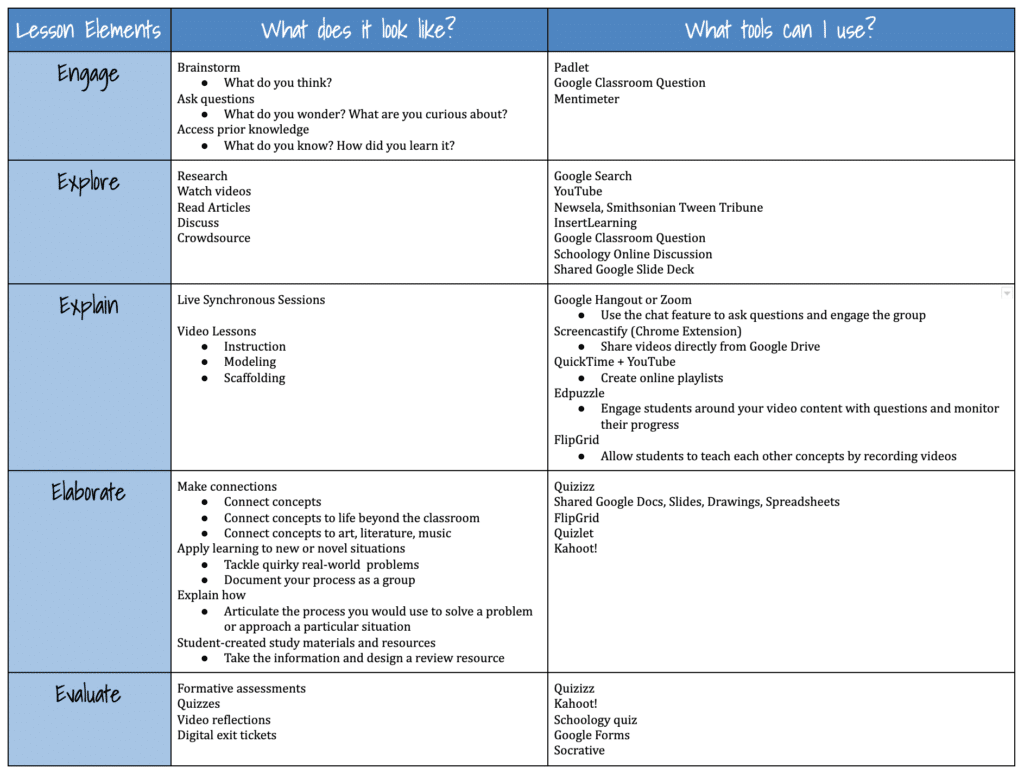
Tips for Designing an Online Lesson Using the 5 Es Instructional Model | https://t.co/LY53NNlMes pic.twitter.com/y4fu55MCFM
— Ana Cristina Pratas (@AnaCristinaPrts) April 12, 2020
https://catlintucker.com/2020/03/designing-an-online-lesson/
the Hyperdoc website and check out the templates and already-created hyperdocs available for teachers. Lisa Highfill, Kelly Hilton, and Sarah Landis are the authors of The Hyperdoc Handbook and have created a website full of free resources for teachers.
++++++++++++
more on instructional design and education in this IMS blog
https://blog.stcloudstate.edu/ims?s=instructional+design+and+education
PDF document: xr-collaboration-global-resource-guide
++++++++++++++
more on XR in this IMS blog
https://blog.stcloudstate.edu/ims?s=xr
https://tours.bemorecolorful.com/v/7R81yaZ91Ad
++++++++++++++
more on 360 in this IMS blog
https://blog.stcloudstate.edu/ims?s=360
There is also a sharp political divide in how concerned parents are about the impact of the coronavirus on their children’s education, a Gallup survey shows. https://t.co/4I5bglvZfJ
— Education Week (@educationweek) April 10, 2020
Two important caveats: The ability to access the internet is crucial for the survey respondents. And the poll has a relatively significant margin of error.
The coronavirus pandemic has forced the vast majority of schools nationwide to close for several weeks; several states and U.S. territories have closed their schools’ doors for the rest of the 2019-20 academic year. At the same time, states and districts have rushed to get remote learning sessions up and running, with varying success.
++++++++++++
more on education and politics in this IMS blog
https://blog.stcloudstate.edu/ims?s=education+politics
#twitterstorians, in the fall, I’m teaching a course called “Fake History,” which will explore commonly held myths and lies about the past. What myth/lie/misconception about the past troubles, irks, annoys, or bothers you the most? (I’m trying to figuring out what I’m missing)
— Eladio Bobadilla (@e_b_bobadilla) April 9, 2020
++++++++++++++
more on history in this IMS blog
https://blog.stcloudstate.edu/ims?s=history
