https://elearninginfographics.com/debunking-common-myths-about-udl-infographic/
Universal Design for Learning (UDL)
categories: educational technology
Digital Literacy for St. Cloud State University
https://elearninginfographics.com/debunking-common-myths-about-udl-infographic/
https://youtu.be/33anEkIr_3M
The eLearning Coach, at https://theelearningcoach.com/ for a multitude of free instructional design resources!
++++++++++++
more on ID in this IMS blog
https://blog.stcloudstate.edu/ims?s=instructional+design
more on Storyline in this IMS blog
https://blog.stcloudstate.edu/ims?s=articulate
https://www.iste.org/explore/education-leadership/hottest-topics-edtech-2022
8. Augmented, mixed and virtual reality
7. Social-emotional learning
6. Equity and inclusion
5. Online tools and apps
4. Distance, online, blended learning
3. Computer science and computational thinking
2. Instructional design and delivery
1. Project-based learning
+++++++++++++++++++++++++++++++++++
It is likely that the effects of gamification cannot easily be measured satisfactorily through surveys of motivation, engagement, attendance, or grades because there are too many variables that could affect how students respond. Critics of gamification argue that it over
simplifies complex problems (Bogost, 2015; Robertson, 2010). However, both gamification and design thinking are approaches to problem-solving. With design thinking, gamification may be used in more meaningful ways because design thinking offers a different lens through which to conceptualize the problem.
Chandrasekera, T. (n.d.). Using Augmented Reality Prototypes in Design Education. Design and Technology Education an International Journal. Retrieved October 12, 2021, from https://www.academia.edu/28187340/Using_Augmented_Reality_Prototypes_in_Design_Education
Technology Acceptance Model (TAM) is the most widely used theoretical framework that looks at technology acceptance and there have been different iterations of the basic model (Fig 3). The two main variables that TAM incorporates are Perceived usefulness and Perceived ease of use (Davis ,1989). The Technology acceptance model was developed in order to identify the user’s intention and bias to use a particular technology based upon its qualities of usefulness and ease of use
The survey was based on the Technology Acceptance Model and contained questions that were modified but previously used in other questionnaires. Technology Acceptance questionnaires contain questions on Perceived Ease of Use (PEU) and Perceived Usability (PU) of the technology as well as the Intent to Use (IU) it later on. For the question “I think I would like to use Augmented Reality in my designs frequently” while 45% agreed or strongly agreed, 45% either disagreed or strongly disagreed.
++++++++++++++++++
More on Technology Acceptance Model in this blog
https://blog.stcloudstate.edu/ims?s=Technology+acceptance+model
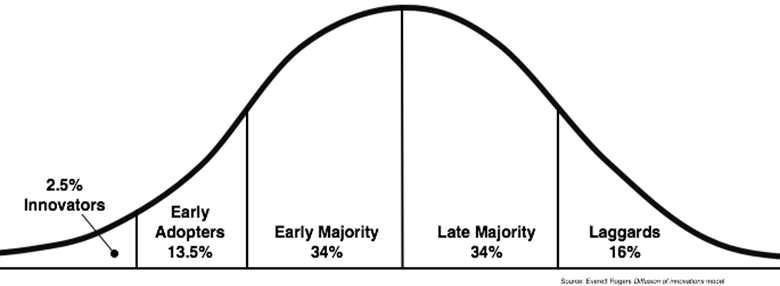
This theory has been used successfully in many fields including communication, agriculture, public health, criminal justice, social work, and marketing.
++++++++++++++++++
more on instructional design in this IMS blog
https://blog.stcloudstate.edu/ims?s=instructional+design
Extend the Learning About a Topic
Deepen Learning Through Prediction
Get People Moving
++++++++++++
more on podcasting in this iMS blog
https://blog.stcloudstate.edu/ims?s=podcasting
+++++++++++++++
more on flipped classroom in this iMS blog
https://blog.stcloudstate.edu/ims?s=flipped+classroom